
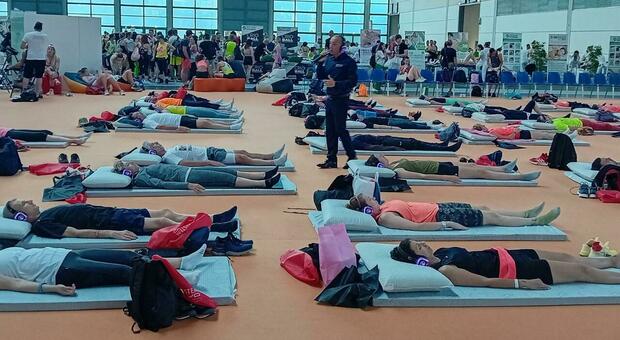
SANTA MARIA DI SALA – It teaches players from Serie A football teams, who also compete in Europe, how to sleep.
To cycling, rugby, basketball, and track and field champions. To bank and corporate executives. He explains that sleep must be “of the right quality and quantity” and that it’s sleeping well that makes the difference on the podium. If needed, the family-run company provides the “bed system,” including pillows and mattresses. The former Australian Benetton Rugby captain posted on social media hugging the mattress he brought home. Real Madrid demonstrates the importance of athletes’ sleep: they spent €55,000 per player to ensure a good night’s sleep before matches.
Loris Bonamassa, 54, from Padua, has a son who works in London. He holds a degree in Business Administration from Ca’ Foscari University of Venice and two master’s degrees. He works as a sleep consultant and has written a book titled “I Am the Sleeping Man.” He transformed his parents’ company from mass production to quality manufacturing. “Dormiflex,” in Santa Maria di Sala, has 120 employees, a turnover of €10 million, and produces over 100,000 bed systems a year. It exports to Europe, Malaysia, Singapore, Dubai, and even Ghana, where it is about to open a factory. Currently at the helm is a family woman, Lisa Insole. This small mattress empire was founded 60 years ago, on October 11th (the celebration is already underway) by Giorgio and Maria Bonamassa, two emigrants who came to the North from a small town in Calabria.
How did the Bonamassa adventure begin?
My father and mother left Oriolo, in the province of Cosenza, on what they called the “train of the sun.” They first worked as laborers in Milan for Bassetti, then moved to Capriccio di Vigonza to work for a small mattress company. When the owners wanted to close down, they bought it with all their savings and a mountain of bills. “Bonamassa materassi a molle” was born, and when it became fashionable to add “flex” to the name, they transformed it into Dormiflex and moved to new warehouses in Santa Maria di Sala. At the time, it was the most important mattress district in Italy; the orthopedic spring mattress was born in the Mirano area. There were excellent factories there, from Maretto to Gesuato.
Has the spring mattress washed away the old wool and horsehair?
There was Pirelli, whose spokesperson was Adriano Celentano, the “super-soft” one. It sold like hotcakes, and after years of exports, another revolution arrived: latex, which changed the concept of mattresses. Latex adapts to the shape of the back; it’s not as hard as orthopedic mattresses; it’s like placing thousands of springs next to each other; the more springs you add, the more it takes into account all the body’s contours. This revolution lasted until the 1990s, when NASA changed everything: for space travel, astronauts needed to be able to sleep without being tied to a bed. An American company invented a mattress made of polyurethane foam. Polyurethane has a memory function; instead of repelling, it accommodates and becomes anti-decubitus. It’s the new era of foam mattresses, and we’re adapting to new technologies and growing so much that my father opened a factory in Calabria in 2001. One of the biggest problems for mattress manufacturers is transportation: a truck trailer can only carry a few hundred! With a factory in the South, it’s easier to supply half of Italy. For my father, it was also a way to restore prosperity to where he’d started with his cardboard suitcase and a third-grade education; he even became mayor of his town. We were a family-run industrial enterprise. From then on, my mother Maria took over the reins of the Veneto factory; they call it Maria’s factory.
What was your relationship with your father like?
He was always a man of very few words; if he remained silent, he agreed; if he remained silent, he said no. He worked every day of his life; instead of telling people what to do, he did it. He never stopped; there was always someone at our house, a supplier, a representative. He was convinced that, as an emigrant who loved his work, he had come to the right place. After graduating, I moved to Austria to manage exports to Europe, when in 2015 my father called me back to the company because he had discovered he had esophageal cancer. He survived a ten-hour operation. I went to see him; he couldn’t speak and he made the sign of the cross with his hands as if it were all over. At that point, in front of my father, who could have died, I asked myself if working meant risking my life. My father slept little and badly, I slept little too, and so I began to think of something that would help me sleep better and live better. In the best of cases, you die of old age. That’s when I wrote my first book.
Was that when your interest in sleep began?
I study, attend courses and master’s degrees, and meet experts and scientists. In Great Britain, coach Sir Alex Ferguson already had sleep protocols for footballers. I talk about sleep quality and the right amount, and I meet with players from Udinese, Benetton Rugby, and Umana Reyer, athletes, and other sportspeople. An athlete must sleep at least seven hours at a time, both physically and mentally. We spend a third of our lives sleeping, and the rest is often influenced by how we sleep. So, in 2016, my career began to separate from Dormiflex. Over these eight years, I have written books, taught courses and conferences, earned a master’s degree in high-performance coaching, am a member of the World Sleep Society, founded an Academy, and taught for sports clubs, large companies, and major banks. The family business continues to operate in the medical, sports, and hospitality sectors. We have repositioned ourselves and today we are the leading manufacturer of functional bed systems for sleep, health, and longevity. I continue to work in commercial marketing.
What does your sleep protocol consist of?
“In five areas of work: 1) knowledge of sleep; 2) objective analysis, i.e., the person’s identity card; 3) subjective analysis, habits, lifestyle; 4) the bed system, which is not just a mattress but many functional elements that improve the quality of sleep; 5) the “sanctuary” of recovery: the bedroom, the environment. All of this intertwines with three worlds: the medical world, which deals with treating the bedridden; the world of professional sports; and the world of ordinary people, from companies to human resources.”
And sports?
To play well, Jannik Sinner needs the ability to sleep while traveling the world, just as he sleeps in his home in Monte Carlo, following sleep training protocols. The Giro d’Italia cyclist—I follow seven of them—changes rooms at every stage, new beds, new hotels, new noises. He needs to standardize his sleep. I’m a consultant for Issa, the world’s leading fitness certification school; we coach Serie A and Serie B soccer teams. In Bergamo, the home of Atalanta, I teach sleep.
And the companies?
After Covid, young people are no longer willing to sacrifice their lives for the company unless the company takes care of them. A factory, any factory, can’t keep you awake at night. If you don’t sleep, you don’t work well. At Banca Generali, we work at all levels to achieve the right balance between day and night, between people, work, and family. “Sleep and Wealth” is the title of the course.